
Why in-house training environments are too big and too small at the same time
Keeping a training operation running costs time. Organising courses, building a separate environment for every date, briefing participants, sorting out the usual login problems on the morning of the course. None of it gets recorded, because the colleagues are on the payroll anyway.
There is a second item that appears on no list either. That one sits in the rack.
Capacity is sized for the peak
A course with 20 participants needs 20 training machines, at the same time, for three to five days. After that nobody needs them. Run that environment yourself and you buy hardware for the peak and carry it all year, depreciation, power and patch cycles included.
So the question is not only what the setup costs, but how much of the purchased capacity ever gets used.
What the data shows
We analysed five typical customer accounts over twelve months each and recorded, for every calendar day, the number of training machines running at the same time. Together that is 1,825 customer days and 6,364 desktop days, ranging from a small vendor with a handful of courses to one with continuous training activity.
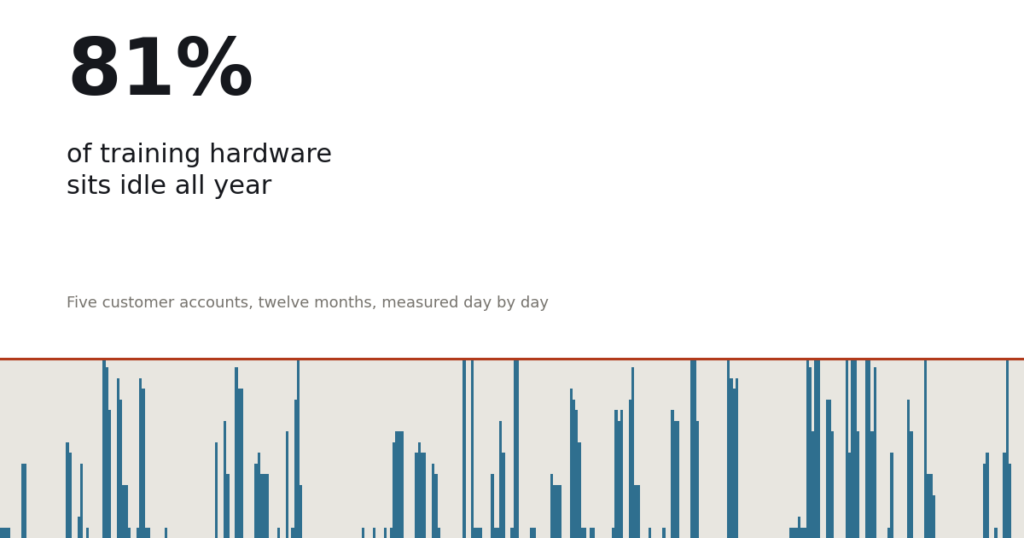
The result: on 61 per cent of all days not a single training machine was running. Of the hardware a vendor would have to buy for its peak demand, four out of five seats sit idle all year.
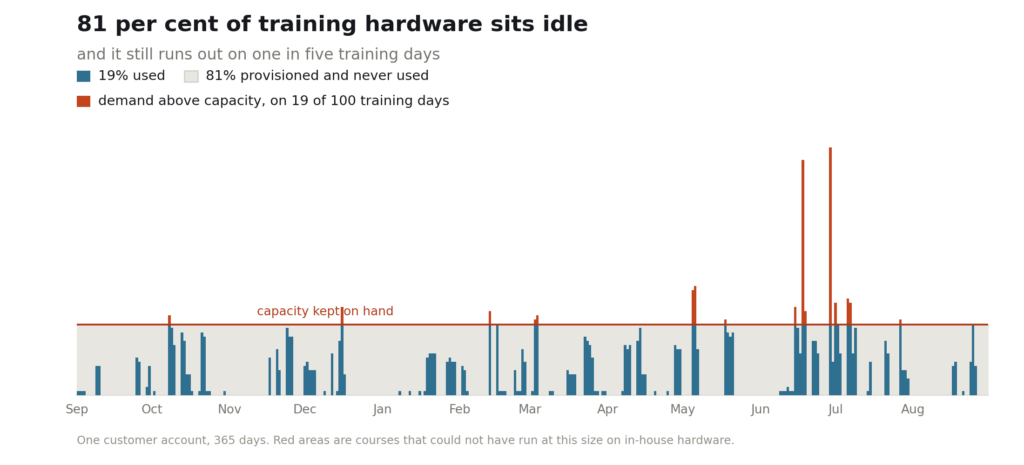
The individual figures for the five accounts, by training volume:
Depending on training volume, the share actually used falls between 14 and 25 per cent. The individual figures for the five accounts:
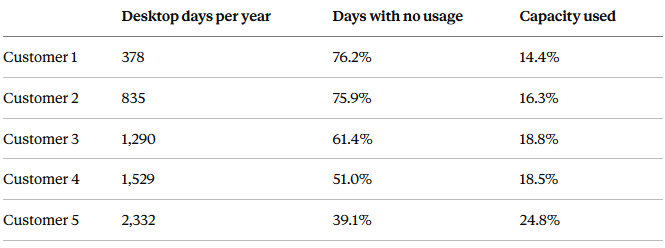
And the capacity on hand still is not always enough. On 10 to 32 per cent of training days demand exceeded the line, because two courses coincided or one course was larger than usual. With your own hardware that means postponing, shrinking or cancelling.
There is an economy of scale, but it runs out quickly: customer 5 trains six times as much as customer 1 and uses less than twice the share of its capacity. Even with continuous training activity across twelve months, three quarters stay unused.
Peak demand here is the level that covers 19 days out of 20. Provision for every single day of the year and you buy more hardware and use it even less.
Three caveats belong with this. First, these numbers measure usage on a platform billed by consumption. On hardware already paid for, the number of sessions would be lower and utilisation therefore worse, not better. Second, the figure refers to calendar days. Count working days only and the numbers look kinder, but the server still sits in the rack over the weekend.
Third, and this is the most important one: every figure assumes an environment without redundancy. A failed server there means no training, with twenty participants from other companies who have already travelled in. Build it redundantly instead and you double the capacity on hand while halving the part that gets used. Nineteen per cent then becomes less than ten.
Back to the hours from the beginning
In the conversations we have with software vendors, organisation, IT and trainer support quickly add up to 18 hours a week, close to half a full-time position. Part of that stays with the vendor wherever the environment runs. Inviting participants, coordinating dates and providing materials belong in that part.
The two costs are connected. Train little and you have too few courses to justify automating the setup fully, while running the worst utilisation. Train a lot and you are more likely to automate, but you size bigger. Either way what remains is one person who knows where the scripts are and which network segment is free. That person goes on holiday, falls ill or resigns. The course is booked regardless.
What this means in practice
Take your last financial year and compare peak demand for simultaneous training machines against the annual average. If you clear 40 per cent capacity used, running it yourself is defensible. Below that you are financing capacity that stands still for most of the year, and tying up working time that would be worth more elsewhere.
Either way, maintaining the content of the training environment always stays with you. Nobody but you knows your software, when an update can safely be applied and what demo data a course needs. Operations can be outsourced, expertise cannot.
That is what deskMate is for: training environments ready in under a minute, billed by days of use, with no cost on days without training. They run on our own redundant server farm, ISO 27001 certified, so a single failed host does not put a booked course at risk.
If you have worked out your own number and want a second opinion on it, get in touch.